Should I Get an Image Critique Before Entering Photography Competition?
Quick Answer
Yes. Getting an image critique before entering photography competition can help you choose stronger entries, identify things you may have overlooked and better understand how your image is working within the judging criteria. But a critique isn't required, and it can't predict what a judging panel will do.
You don't need someone's permission to enter.
The goal isn't to have someone predict the result. It's to understand what's working, what could be strengthened and what you might not be seeing anymore because you've stared at the image for entirely too long.
This article focuses primarily on image competition within the Professional Photographers of America (PPA) and PPA Community Network ecosystem.
If you're completely new to photography image competition, start with how to get started with photography image competition before worrying about whether you need a critique.
What Can a Pre-Competition Critique Help With?
Sometimes you know there's something about an image that isn't quite working, but you can't figure out what it is.
Sometimes you're deciding between three images and your personal favorite isn't necessarily the one with the most competition potential.
And sometimes there's a bright little distraction sitting right there in the corner that you have somehow managed not to see for the last four hours.
It happens.
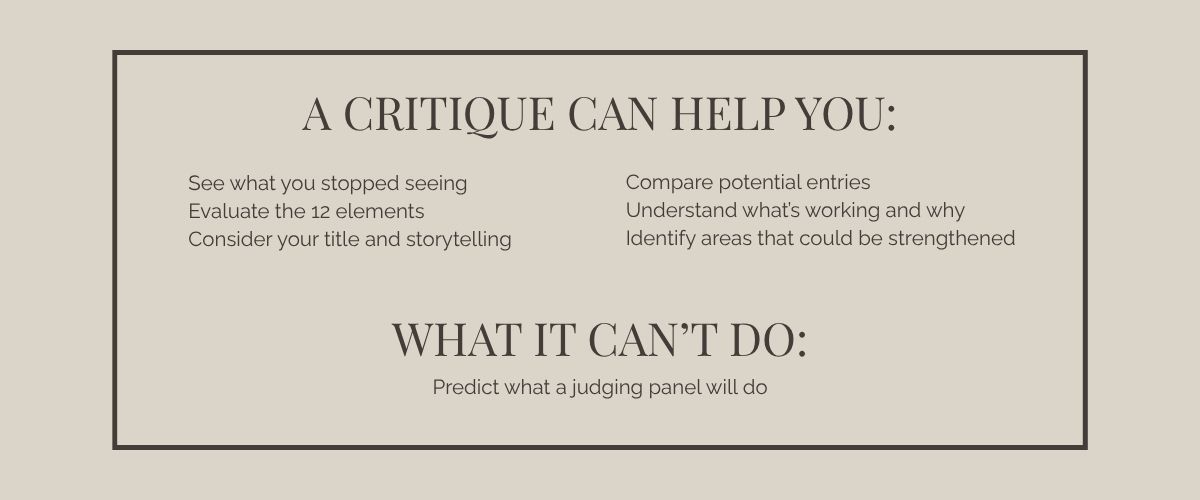
A good pre-competition critique can help you look at things like composition, lighting, technical execution, presentation, storytelling, impact and the other 12 Elements used within the PPA image competition system.
It can also help you decide whether you're working on the right image in the first place.
Choosing images for photography competition is a skill of its own.
There isn't much benefit in spending six more hours perfecting Image A if Image B has considerably more potential.
Through my own years of entering image competition, working with photographers on their competition images, helping administer competitions and now going through juror training, I've seen how useful good feedback can be.
But I've also seen why you need to know what to do with that feedback.
Does the Title Matter in Photography Competition?
Yes.
Titles are so important in image competition that you'll frequently hear them referred to as the “13th Element.”
Your title works closely with storytelling.
It's the one chance you have to speak to the judges before or during the judging of your image, and you can use it to help lead them toward the story you want them to see.
That's why, when I'm critiquing a competition image, I want to know the title too.
If the image appears to be telling one story while the title sends the judges somewhere completely different, that's worth talking about before you enter it.
Choosing a strong title doesn't mean explaining the image to the judges.
It means giving them another piece of information that supports the story you're already trying to tell.
Make Sure You're Asking the Right Person
Getting another photographer's opinion isn't necessarily the same thing as getting an image competition critique.
Your photographer friend may be incredibly talented.
They may also know absolutely nothing about the competition you're entering.
Those two things can be true at the same time.
When I first started entering image competition, I sought out a photographer whose work I admired and who consistently did well in competition to mentor me.
And it still took me about six months to wrap my head around one particular idea:
An image I loved might not do well in image competition.
That was hard for me at first.
Why couldn't the judges see what I saw?
But eventually I understood that those things aren't mutually exclusive.
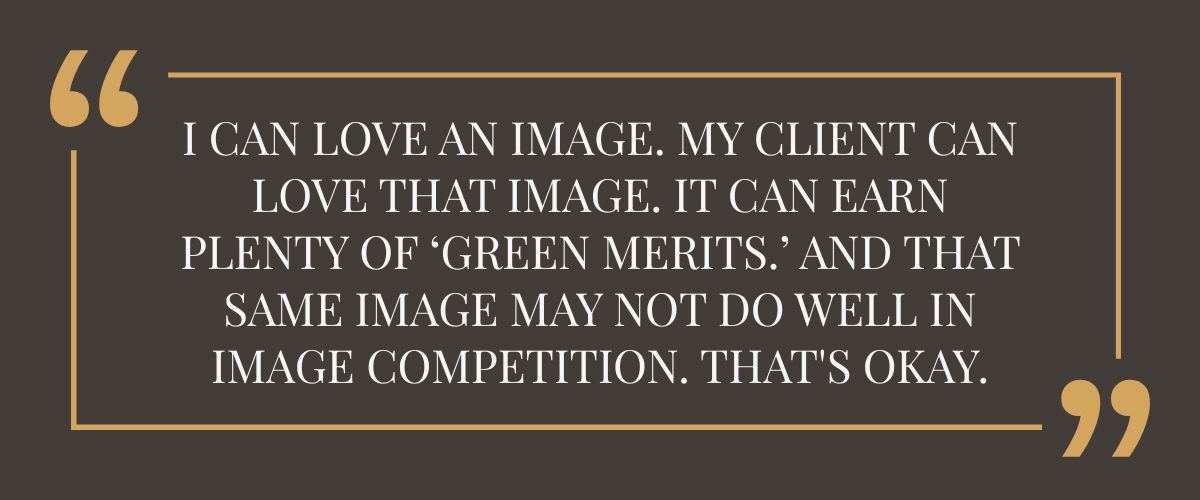
I can love an image.
My client can absolutely love that image.
That image can earn plenty of “green merits,” otherwise known as money.
And that same image may not do well in image competition.
That's okay.
It doesn't suddenly make the photograph bad.
It means the image is being evaluated for a different purpose and through a particular set of criteria.
Learning that distinction was a big part of learning image competition for me. And it's one of the reasons I think it matters who you ask for competition feedback.
If you're seeking feedback specifically for competition, look for someone who understands the competition you're entering, its rules and its judging criteria.
Within the PPA ecosystem, that also means understanding the 12 Elements of a Merit Image and how they work together.
“I like it” is nice.
It just isn't particularly useful competition feedback.
A useful critique should help you understand why the image is or isn't succeeding within that competition environment.
Please Don't Critique Your Image to Death
There is such a thing as too much feedback.
You show the image to one person.
Change it.
Show it to someone else.
Change it again.
Put it in a group.
Get seven more opinions.
Change it again.
By opinion number nine, you may not even remember what you liked about the image in the first place.
A critique is information.
It isn't an instruction manual.
You don't have to make every change someone suggests.
Listen to the feedback. Ask questions. Decide whether it makes sense to you and whether the change strengthens what you're trying to communicate.
It's still your image.
A Critique Is Feedback, Not a Prediction
This is probably the most important thing to understand before you ask someone to critique a competition image.
Nobody knows what another judging panel is going to do.
A critique can identify the things that are working well in an image, areas that could be strengthened and how the image is working within the 12 Elements.
What it can't do is guarantee a result.
That's why I don't tell someone, “This image will merit.”
I don't know that.
Neither does anyone else until the image goes through the process.
Put the same image in front of two different panels and you may not get the same result. That's one of the realities of image competition.
A good critique isn't trying to predict the future. It's helping you understand the image sitting in front of you right now.
What is working?
What keeps pulling the viewer's attention?
Where could the storytelling be stronger?
Is there something technical or presentational that deserves another look?
Those are conversations you can actually use.
The goal isn't to walk away with a prediction.
It's to walk away understanding your image better.
Can I Get an Image Critique After Photography Competition?
Yes. Pre-competition critiques aren't your only opportunity to get feedback.
PPA's Merit Image Review offers an optional paid critique that can be ordered as part of the entry process and delivered after the review.
Many local and state PPA Community Network partners also offer paid critiques after their competitions.
How those critiques are ordered varies.
Some competitions require you to purchase the critique when you submit your entry. Others may allow a short period after the competition, sometimes 24 to 36 hours, to decide whether you'd like to order one.
Check the rules for the competition you're actually entering. Don't assume the critique process works the same way just because another competition gave you 36 hours to decide.
And don't think of a post-competition critique as something you missed the chance to use.
It just serves a different purpose.
Before competition, you're asking:
What should I consider before I submit this?
After competition, you're asking:
What can I learn from what happened?
Let's say you enter an image you're convinced is going to do well.
It doesn't.
Your first reaction might be some version of:
Well. Apparently they hated it.
That's probably not the lesson we want to take from this.
A post-competition critique can help you understand what may have influenced the result, what was working well and what could have been stronger.
If the image is eligible to be revised and entered again, that feedback may help you decide what you want to change.
But even if you never enter that image again, the critique can still matter.
Because the best thing you learn from an image critique may have absolutely nothing to do with that particular image.
The Best Critiques Follow You Into the Next Image
A critique becomes much more valuable when you stop thinking of it as a list of corrections.
The goal isn't:
Move this.
Crop that.
Darken this.
Fix that.
The bigger goal is understanding why.
Why does that bright area keep pulling your eye away from the subject?
Why does the composition feel unbalanced?
Why isn't the story coming through the way you intended?
Why does one presentation strengthen the image while another weakens it?
Once you understand the why, you can start seeing those things yourself.
And that follows you into the next image.
Then the image after that.
That's where critique becomes education instead of simply preparation for a competition.
The Bottom Line
You don't need an image critique before entering photography competition.
But sometimes another trained set of eyes is exactly what you need.
Get a critique when you want help choosing between images, when you can't figure out what's bothering you or when you want to understand why something is or isn't working.
Get one after competition when you want to understand the result and what you can learn from it.
Just don't use a critique as permission to enter or as a prediction of what a panel will do.
The goal is to understand your image better.
And ideally, learn something you can carry into the next one.
If you'd like another set of trained eyes on your competition images, I offer private Image Critiques designed to help you understand what's working, what could be strengthened and, most importantly, why.