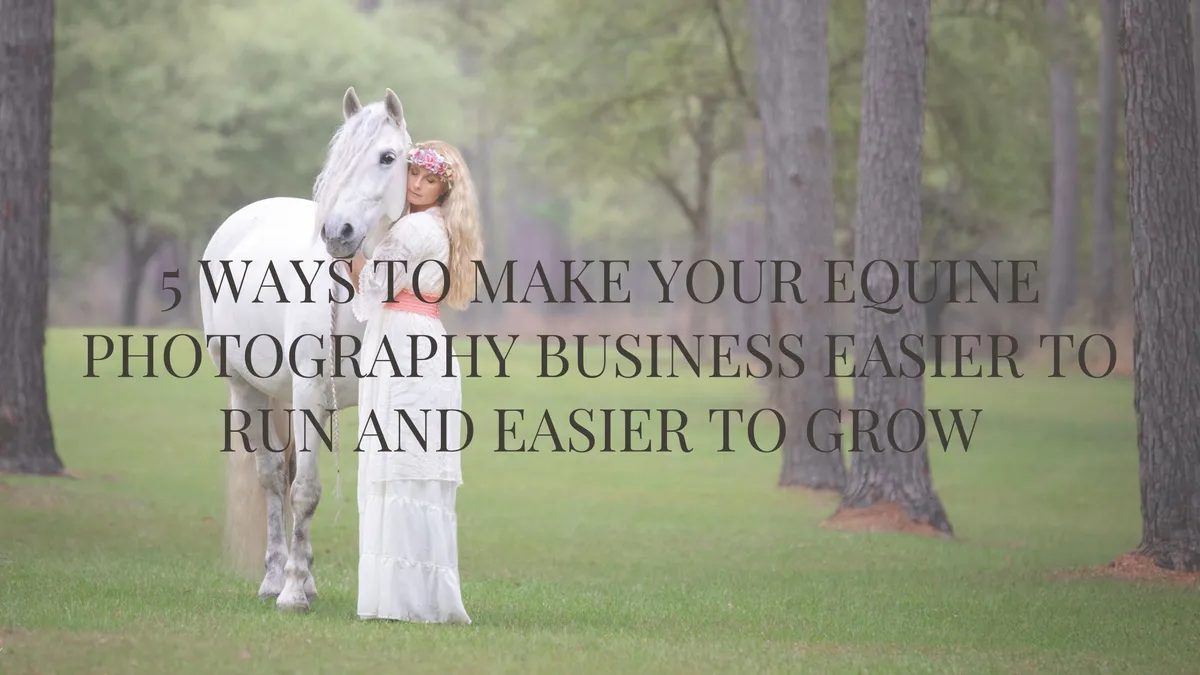
5 Ways to Make Your Equine Photography Business Easier to Run and Easier to Grow
There comes a point in almost every photography business when adding more stops helping.
More session types. More products. More marketing. More software. More things you're supposed to be doing because some photographer on the internet said they're doing it and apparently sleeping eight hours a night while they're at it.
Meanwhile, you're sitting there wondering why growing your equine photography business somehow made the business harder to run.
Sometimes growth doesn't start with adding something.
Sometimes it starts with taking something away.
This is something I talk about quite a bit when I'm mentoring photographers. If we were sitting down together right now, giant tumbler of ice water in hand (or coffee if you roll that way), I wouldn't immediately start handing you seventeen new things to do.
I'd probably start asking questions.
What's working? What's making money? What's taking way more time than it should? What are you doing because it actually helps your business, and what are you doing because at some point you decided a “real” photography business was supposed to do it?
Because growing an equine photography business isn't necessarily about doing more.
Sometimes it's about making what you're already doing work better.
1. Simplify Before You Add Something Else
Photographers are good at adding things. Really good.
We add another session option. Another product. Another promotion. Another social platform. Another piece of software that is absolutely going to change our lives because this time we've definitely found the one.
Then six months later we're managing twelve session types, seventeen products, five marketing channels, four pieces of software that basically do the same thing, and a promotion we can't remember why we created.
More isn't automatically better.
Sometimes more is just...more.
Before you add something new to your equine photography business, look at what you already have.
Are clients confused by all the different session options?
Do you have products on your price list that nobody ever buys?
Are you spending hours creating content for a platform that has never brought you a client?
Is your workflow complicated because it genuinely needs to be, or because you've kept adding steps without ever removing any?
And here's one horse photographers are particularly good at: creating another special type of session.
Horse and rider. Black background. Horse at liberty. Senior portraits. Holiday sessions. Minis. Barn days. Horse shows. Branding. Fine art. Farm sessions.
Any of those can be a great offer.
That doesn't mean your business needs all of them.
Every offer you add has to be explained, priced, marketed, scheduled, delivered, and maintained. It takes up space in your business even when nobody is buying it.
So before you add the next thing, ask yourself whether something else needs to go.
A simpler business is usually easier to market, easier for clients to understand, and a whole lot easier for you to run.
2. Set Boundaries Before You Need Them
Boundaries are much easier to establish before you're standing in a barn aisle trying to explain them to an unhappy client.
Ask me how I know.
Horse photography comes with plenty of situations where boundaries can get fuzzy.
Weather changes. Horses decide today is not the day they're participating in your creative vision. Barn schedules shift. Clients run late. Someone asks whether you can photograph another horse “really quick” while you're already there.
And then there are the messages.
A client sends a text at 10:30 p.m. You see it. You know the answer. It would only take thirty seconds to respond.
So you do.
Do that often enough and you've accidentally taught people that 10:30 p.m. is a perfectly reasonable time to reach you.
That's the thing about boundaries. They're not only something you tell people. They're also something you teach through your own behavior.
Your pricing, office hours, travel policies, rescheduling policies, turnaround times, payment requirements, and what is or isn't included in a session should not be mysteries your clients have to solve.
A lot of those boundaries become much easier when your client communication is consistent from the beginning.
And you don't need to feel guilty about having them.
A client asking for something doesn't automatically mean you have to say yes.
Sometimes the answer is, “Absolutely.”
Sometimes it's, “Yes, here's what that costs.”
And sometimes it's simply, “No, I don't offer that.”
All three are perfectly reasonable answers when you're running a business.
3. Fix the System Before You Hire the Person
There's a point in business when outsourcing can be wonderful.
Maybe you hate editing. Maybe bookkeeping makes you want to fake your own disappearance. Maybe you're spending hours doing something another person could do faster and better while you concentrate on work that actually requires you.
But before you hire someone, figure out what problem you're trying to solve.
Because sometimes you don't have a people problem.
You have a process problem.
If your client workflow is a mess, hiring an assistant doesn't magically fix it. Now you have two people trying to figure out what happens next.
Congratulations. You're paying someone else to participate in your mess.
Before outsourcing, look at the task itself. Does it need to be done? Does it need to be done this way? Could part of it be automated? Could you create a template? Is information stored somewhere another person could actually find it? Is there a repeatable process?
And, possibly the most important question, do you need another person or do you need a better system?
Once the process works, outsourcing becomes much easier because you can actually explain what needs to happen.
You also don't need a huge team to have a successful equine photography business.
There is no prize for having the most contractors, assistants, editors, social media managers, virtual assistants, or people with impressive job titles in your Slack account.
If hiring someone gives you back valuable time, allows you to serve clients better, or helps the business grow profitably, great.
Hire the help.
But don't build a team because you think having a team is what successful photographers are supposed to do.
4. Stop Building the Business You're Supposed to Have
This one can sneak up on you.
You start your horse photography business and naturally look around to see what other photographers are doing.
That's not necessarily a bad thing. We all need somewhere to start.
The problem comes when you stop asking whether any of it makes sense for your business.
Another equine photographer sells a particular product, so you add it.
Someone says Instagram Reels are the only way to market now, so you start making Reels even though you hate every second of it.
Another photographer launches mini sessions, so maybe you should offer mini sessions.
Someone has a studio. Maybe you need a studio.
Someone has an assistant.
Someone sells albums.
Someone doesn't sell albums.
Someone photographs thirty sessions a month.
Someone photographs six.
And pretty soon you're piecing together a photography business from everybody else's businesses.
Here's what matters more:
What works for you and your clients?
What do you actually enjoy photographing?
What do your clients want to buy?
What is profitable?
What kind of schedule do you want?
How far do you want to travel?
How many sessions can you reasonably photograph and still provide the experience you want to provide?
Maybe you want a high-volume equestrian photography business. Maybe you'd rather photograph fewer clients and sell more to each one. Maybe you love horse shows. Maybe the idea of photographing a horse show makes you want to hide in the trailer.
There isn't one correct way to build an equine photography business.
You don't have to recreate somebody else's version of success.
You need to build a business that works for your clients, makes financial sense, and works for you.
5. Build a Business That Leaves Room for a Life
There's a version of business growth that looks great from the outside.
The calendar is full. You're photographing constantly. Emails are coming in. Orders are going out. You're busy enough to tell everyone how insanely busy you are.
And you are exhausted.
That's not necessarily growth.
Sometimes that's a capacity problem wearing a cute little success hat.
Your business has a limit to how much work it can handle before something has to change. And if you're the photographer, editor, marketer, salesperson, bookkeeper, customer-service department, website manager, product-ordering department, and person currently wondering whether there is anything in the refrigerator that counts as dinner, that limit may arrive sooner than you think.
This is where pricing, systems, boundaries, and capacity all start bumping into each other.
If your prices require you to photograph more sessions than you can reasonably handle, that's a problem.
If every client requires hours of unnecessary administrative work, that's a problem.
If you're responding to messages seven days a week because you've never established office hours, that's a problem.
If you're so booked that you can't take a day off without everything falling apart, that's a problem too.
The goal isn't to build a business where you never work hard. There will absolutely be busy seasons, long days, unexpected problems, and weeks when your schedule looks slightly unhinged.
That's business.
But that shouldn't be every week forever. And, if your business follows you into every available hour simply because you work from home, figuring out how to run your equine photography business from home without working all the time is part of this too.
Your equine photography business should support the life you're trying to build, not consume it.
And sometimes the smartest growth decision isn't figuring out what else you can squeeze in.
It's deciding what you don't need to do anymore.
Growth Doesn't Always Mean More
It's easy to look at business growth as a constant exercise in addition.
More clients. More sessions. More products. More followers. More revenue. More offers. More people.
But a bigger business isn't automatically a better business.
Sometimes growth looks like simplifying an offer that's become too complicated. Raising prices so you don't need as many sessions. Creating a workflow that gives you hours back every week. Saying no to work that doesn't fit anymore. Dropping a marketing platform that takes a ton of time and produces nothing.
Sometimes it's finally admitting that something you thought would work...didn't.
That's allowed.
Your business is going to change as you do. The equine photography business you needed when you started may not be the business you need five years from now.
Keep what works.
Change what doesn't.
And before you add another thing to your business because somebody told you that's what you're supposed to do, ask yourself one question:
Is this actually going to make my business better, or is it just going to give me more to do?