New Equine Photographer FAQ: Answers to the Questions You're Probably Asking
When you're new to equine photography, you have questions.
A lot of questions.
Some are about photography. Some are about horses. Others are about the business side nobody mentioned when you first thought, “Hey, photographing horses for a living sounds fun.”
And it is fun.
It also comes with contracts, insurance, pricing, websites, backups, marketing, taxes, and approximately 47 other things that have absolutely nothing to do with pressing the shutter button.
Welcome to professional photography.
If you're thinking about becoming an equine photographer, you need more than a camera and a love of horses. You need consistent photography skills, enough horse knowledge to work safely, appropriate business foundations, a way to find and serve clients, and systems that allow you to deliver what you've promised.
You don't need to know everything before you begin.
You do need to know what questions to start asking.
If you're still figuring out the bigger picture of turning your love of horses and photography into an actual business, start with So You Want to Be an Equine Photographer? What to Know Before You Build the Business.
Then come back here.
Because these are some of the questions that tend to come next.
Do I Need to Set Up a Legal Business Before Accepting Photography Clients?
If you're accepting money for photography, you need to understand what is required to legally operate a photography business where you live.
Those requirements vary.
Depending on your location, you may need to register your business, obtain licenses or permits, collect and remit applicable sales taxes, report business income, or meet other local and state requirements.
Don't assume that because someone in a photography Facebook group didn't have to do something, you don't either.
They may live 1,500 miles away.
They may also just be wrong.
Talk with qualified legal and tax professionals in your area and find out what applies to your particular business.
It is much easier to build the business correctly from the beginning than discover two years later that you've accidentally created yourself a very expensive problem.
Should an Equine Photographer Be a Sole Proprietor or an LLC?
There isn't one business structure that's automatically right for every equine photographer.
A sole proprietorship, limited liability company, corporation, or another structure may make sense depending on where you live, your income, how your business operates, your assets, tax considerations, and other factors.
And an LLC isn't a magical force field.
Forming one doesn't automatically eliminate every possible liability or replace the need for appropriate contracts, insurance, and good business practices.
This is one of those decisions worth discussing with qualified legal and tax professionals who understand the laws where you operate.
Make the decision based on your actual business.
Not because someone on Instagram told you that's what “real businesses” have.
What Insurance Does an Equine Photographer Need?
If you're photographing horses professionally, insurance deserves your attention.
A lot of it.
Depending on how your business operates, you may need to discuss general liability, equipment or business property coverage, commercial auto coverage, workers' compensation if you have employees, and other types of business insurance with a qualified insurance professional.
But there's another important part of that conversation.
Tell them you photograph horses.
You're not simply photographing people inside a controlled studio. You may be working at barns, farms, horse shows, arenas, fields, private properties, public locations, and other people's facilities.
And then there are the horses.
Lovely creatures.
Also capable of going from peacefully eating grass to WE ARE ALL GOING TO DIE BECAUSE THAT LEAF MOVED with very little warning.
Explain what you actually do to your insurance professional. Ask questions about the situations you regularly work in and make sure you understand what your policy does and doesn't cover.
Your insurance should fit the business you're actually running.
Do I Need to Know Horses Before I Photograph Them Professionally?
Yes.
You don't need to be a professional horse trainer or have spent your entire life riding, but you need enough horse knowledge to work around them safely and confidently.
Learn basic equine behavior and body language.
Know where it's safe to stand.
Recognize when a horse is frightened, uncomfortable, distracted, irritated, or simply finished cooperating with whatever brilliant photography idea you had planned.
You also need to understand how your own behavior affects the horse.
Your movements matter. Your equipment matters. Your assistants matter. Even something seemingly harmless can create a completely different reaction from one horse to another.
Horse knowledge affects the photographs, too.
Equestrians notice things.
Ears.
Legs and Hooves.
Tack.
Reins.
Leads.
Rider position.
Conformation.
Expressions.
And yes, the manure pile you somehow did not see while photographing but which becomes approximately the size of a Volkswagen when you open the image on your computer.
Understanding horses helps you notice those things before you press the shutter.
More importantly, it helps keep everyone safe.
No photograph is worth putting yourself, your client, or a horse in a dangerous situation.
What Camera and Lens Do I Need for Equine Photography?
There isn't one camera body you have to own to become an equine photographer.
When it comes to lenses, though, I have a much stronger opinion.
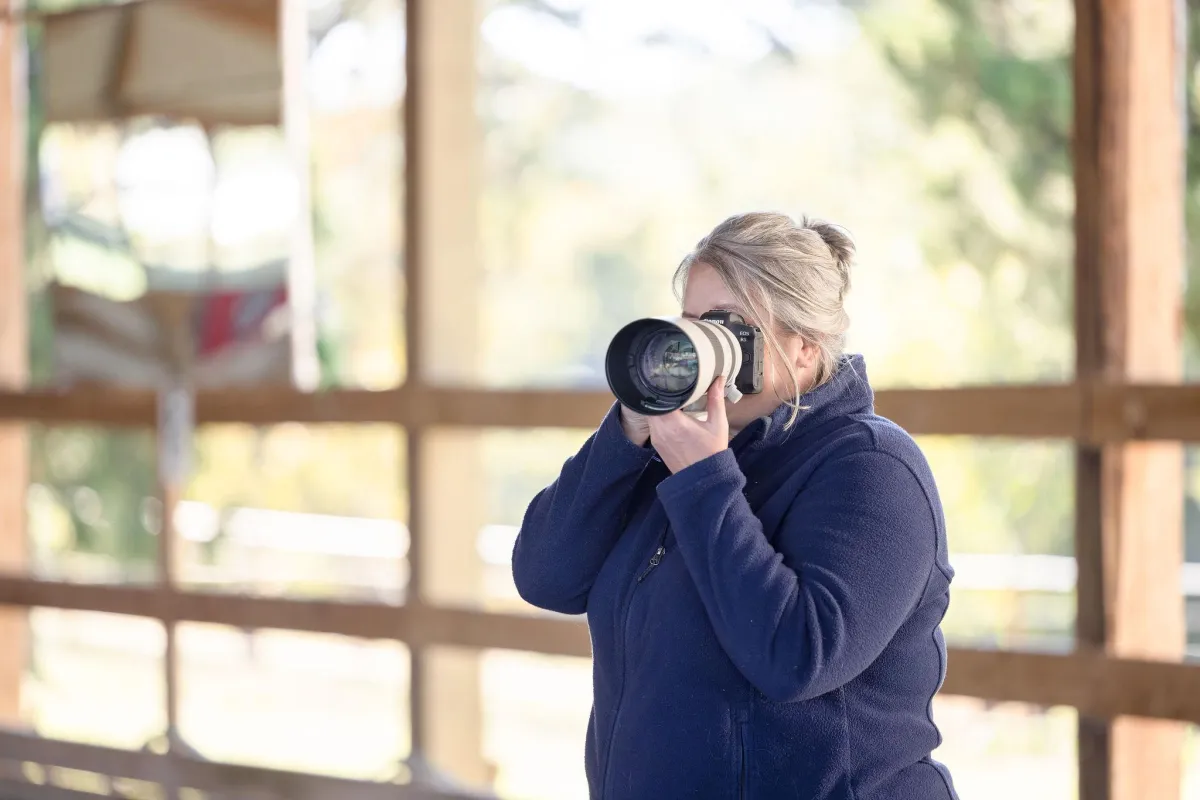
For equine portrait photography, a 70–200mm lens is one of the most useful lenses you can own, and there's a reason you'll see it in the bags of so many professional equine photographers.
Horses have long bodies, long necks, and long faces.
Shorter focal lengths, particularly when you're working close to the horse, can exaggerate whatever is closest to the camera. That can leave you with an enormous head, a tiny hind end, or proportions that don't look quite right.
Generally speaking, that's not the artistic statement we're trying to make.
Longer focal lengths allow you to work farther from the horse and create a more natural-looking perspective. A 70–200mm also gives you flexibility for photographing horses alone, horses with their owners, and horse-and-rider portraits without constantly changing lenses.
Does that mean it's the only lens you'll ever use?
No.
Different types of equine photography require different tools. Horse shows, arena sports, commercial work, environmental portraits, and other situations may call for different focal lengths or equipment.
But if you're building a kit specifically for equine portrait photography, a 70–200mm belongs very high on the list.
As for the camera body, choose it based on what you actually photograph.
Think about autofocus performance, low-light capability, image quality, file size, ergonomics, and whether you're primarily photographing portraits, fast action, events, or some combination of those things.
Buy equipment because it allows you to create the work you intend to create.
Not simply because another photographer owns it.
Should Equine Photographers Shoot RAW or JPEG?
For most professional equine portrait work, I prefer photographing in RAW.
RAW files retain considerably more image information than JPEG files, which gives me more flexibility when I'm working with exposure, white balance, highlights, shadows, and color during post-production.
And horses can make exposure interesting.
Dark horse. Light markings. Bright sky. Deep shadows.
Why make life harder than it already is?
JPEG files are processed and compressed in-camera, which means there is less image information available for later adjustments. However, there are photography workflows where JPEG, or RAW+JPEG, may make sense.
High-volume events with a fast turnaround are one example.
The important thing isn't choosing RAW because somebody told you professional photographers have to shoot RAW.
Understand what each file format gives you.
Then choose the one that makes sense for the work you're creating and the way you need to deliver it.
Do Equine Photographers Need a Website?
I strongly recommend having one.
Social media can absolutely help market an equine photography business, but your entire online presence shouldn't depend on a platform you don't control.
Your website is your digital home.
It gives potential clients somewhere to see your work, learn who you are, understand what you offer, get answers to their questions, and figure out what they should do next if they want to work with you.
It also gives search engines and AI systems useful information about your business, services, expertise, and the subjects you photograph.
Instagram has a job.
Facebook has a job.
Your website has a different one.
Don't make someone scroll through three years of social media posts trying to determine whether you actually photograph horses professionally, what you offer, and how on earth they're supposed to hire you.
Make it easy.
How Do I Get My First Equine Photography Clients?
Start by getting specific about what you want to photograph and who you want to photograph it for.
“Anyone with a horse” is not a marketing strategy.
If you want to photograph horse-and-rider portraits, your portfolio should show horse-and-rider portraits.
Want to photograph equestrian seniors?
Create work that shows potential clients what an equestrian senior session with you could look like.
If commercial equine photography is your goal, your portfolio needs to demonstrate that you can create the kind of images equestrian businesses actually need.
Then start building relationships within the communities you want to serve.
That might include barns, trainers, riding clubs, breed organizations, tack shops, equestrian businesses, horse shows, local events, and other places where your potential clients already spend their time.
But don't walk into every barn within driving distance and immediately start asking what everyone there can do for your business.
Relationships work better when they're actually relationships.
Be involved.
Be useful.
Get to know people.
And make sure that when someone eventually asks, “Do you know somebody who photographs horses?” there is absolutely no confusion about what you do.
Should I Photograph Horses for Free While Building My Portfolio?
Sometimes. But do it intentionally.
There is a big difference between creating a portfolio-building session because you need specific work and photographing everyone who asks because you're afraid to charge.
Before planning a portfolio session, ask yourself what you're actually missing.
Maybe you need a particular breed.
Maybe you need a horse-and-rider combination, an equestrian senior, a specific type of location, a different lighting situation, or images with a more commercial feel.
Then design a session specifically to create those photographs.
You're not looking for any free horse willing to stand in front of your camera.
You're creating something your portfolio needs.
Once you've created the work, move forward.
Portfolio building should have a purpose.
It should not become your permanent business model.
When Am I Ready to Start Charging for Equine Photography?
You don't have to be the best equine photographer in your market before you're allowed to charge money.
You do need to be able to consistently deliver what you're promising.
That's the important part.
You should understand your equipment well enough to use it reliably, produce work of reasonably consistent quality, work safely around horses, communicate professionally with clients, have the appropriate business pieces in place, and deliver the product or service someone paid you for.
One beautiful photograph from one spectacular session doesn't necessarily mean you're ready.
Consistency matters.
Ask yourself:
Can I create the quality I'm showing in my portfolio again with another horse, another client, another location, and different conditions?
A paying client isn't hiring you for the possibility that you might create something wonderful.
They're paying you to deliver.
How Much Should a New Equine Photographer Charge?
There is no universal beginner price for equine photography.
I know.
It would be considerably easier if I could give you a number and send you on your way.
Your pricing needs to account for the actual cost of running your particular business. That includes obvious expenses and the sneaky ones that quietly nibble away at your bank account while you're busy photographing horses.
Think about your time, taxes, insurance, software, equipment, travel, education, products, payment processing, marketing, website, professional services, and other operating expenses.
Then there's profit.
Because revenue and profit are not the same thing.
Simply finding another equine photographer's price list and charging a little less isn't a pricing strategy.
You don't know their expenses.
You don't know their average sale.
You don't know their financial goals.
You may not even be selling the same thing.
Learn what it actually costs to operate your business, decide what you need the business to produce financially, and build your pricing from real numbers.
Your prices need to support your business.
How Do I Stand Out From Other Equine Photographers?
You don't need to invent a style of photography nobody in recorded history has ever seen.
You do need to give people a reason to remember you.
That may come from your photographic style, client experience, products, personality, expertise, the people you serve, your approach to horses, or some combination of those things.
Trying to appeal to absolutely everyone usually makes it harder for anyone to understand why they should choose you.
Pay attention to what clients consistently mention about working with you.
Notice which photographs you most enjoy creating.
Look at the things you naturally do differently rather than manufacturing differences because somebody told you that you need a “unique selling proposition.”
And remember that your brand isn't just your logo, fonts, and colors.
It's the collection of things people begin to associate with you.
Give them something worth remembering.
Should I Follow Other Equine Photographers for Inspiration?
I only follow a few equine photographers.
That's intentional.
I don't want to spend so much time looking at other equine photography that their work begins influencing what I create without me even realizing it.
If you're constantly consuming photographs from your own genre, it's easy to start seeing the same poses, locations, lighting, compositions, and ideas.
Eventually, you may start creating variations of things you've already seen.
I'm much more likely to follow photographers working in completely different genres.
I'll look at fashion photographers for styling and posing.
Architectural photographers for composition and the use of space.
Portrait photographers for lighting and connection.
Commercial photographers for storytelling and branding.
Sports photographers for timing.
And I don't limit inspiration to photography.
Movies, advertising, paintings, graphic design, and other forms of visual art can teach you about light, color, composition, mood, movement, and storytelling.
Then I can ask:
How could I interpret this with a horse?
That's a very different question from:
How can I make a photograph like another equine photographer made?
There are equine photographers whose work I admire, and there's value in knowing what's happening within our industry.
I just don't want equine photography to be the primary source feeding my creativity.
I'd rather bring ideas into equine photography than keep recycling ideas that are already there.
Do I Need a Photography Degree to Become an Equine Photographer?
No. A photography degree generally isn't required to operate a professional equine photography business.
That doesn't mean education isn't important.
It is.
You can learn through college programs, workshops, professional photography organizations, classes, mentoring, online education, image competition, assisting other photographers, and a whole lot of practice.
Different people learn differently.
Choose education based on what you need to learn and how you learn best.
And remember that photography education and business education solve different problems.
Knowing how to create a beautiful photograph doesn't automatically teach you how to price it, market it, sell it, communicate with the client, manage the money, or build a sustainable business around it.
Learn both.
How Should I Back Up My Equine Photography Images?
Your photographs shouldn't exist in only one place.
Ever.
Hard drives fail. Computers die. Files become corrupted. Equipment gets stolen. Buildings flood. Humans accidentally delete things.
Humans are especially troublesome.
A professional backup strategy should include multiple copies of important files, ideally stored in more than one physical location, with at least one copy protected from something happening to your primary workspace.
The exact system can vary.
The principle doesn't.
You need redundancy.
And backups need to be part of your normal workflow rather than something you suddenly remember approximately once every six months while experiencing a wave of panic.
One more important distinction:
If an image exists on an external hard drive and nowhere else, it isn't backed up.
It's stored.
Those are not the same thing.
What Should a New Equine Photographer Focus on First?
Not everything.
That may be the most important answer in this entire article.
It's very easy to convince yourself that you need a better camera, perfect website, bigger portfolio, different logo, another class, more followers, better editing, more confidence, and twelve additional things before you're allowed to move forward.
You don't.
Learn to create consistent photographs.
Learn horses.
Get the legal and financial pieces of your business in order.
Make sure you have appropriate insurance.
Figure out what you're selling and who you're selling it to.
Learn how to communicate with clients.
Create a simple process that moves someone from inquiry through the photography experience and all the way to delivery.
Then keep improving.
You don't have to build the entire business this afternoon.
Build the next piece.
Then the next one.
Keep doing that long enough, and eventually all those pieces start looking suspiciously like a business.