How to Write a Mission Statement for Your Equine Photography Business
When most photographers start a business, I don't think a mission statement is very high on the list.
You're trying to figure out what to charge, how to get clients, whether you really need insurance, what should be in your contract, how you're going to deliver images, and about a hundred other things you didn't realize were part of owning a photography business.
Sitting down to ponder the mission of the company probably isn't happening.
And that's okay.
But once you've been doing this for a while, I think there's some value in circling back and asking yourself a pretty simple question:
What is this business actually here to do?
You might be thinking, Well, Betsy, I photograph horses.
Yes. Obviously.
But that's not really the whole answer, is it?
Two equine photographers can live in the same town, photograph the same kinds of horses, and be building completely different businesses.
One may want to create large pieces of artwork for horse owners' homes. Another may love photographing horses at liberty. Someone else may specialize in equestrian seniors. Another photographer may work primarily with equestrian businesses.
They all photograph horses.
But what they're trying to accomplish with that photography is very different.
And that's where having a mission statement for your photography business starts to become useful.
Quick Answer
A mission statement for an equine photography business is a short statement that explains who you serve, what you do for them, and why that work matters. Unlike a vision statement, which describes where you want the business to go, your mission focuses on the purpose of the business you're running now.
It doesn't need to explain every single thing your business does. Ideally, it should be specific enough to describe your business and useful enough to help guide decisions about what belongs in it and what doesn't.
What's the Difference Between a Mission Statement, Vision Statement, and Brand Values?
Nope, they're not all the same thing.
They're related, which is probably why they tend to get dumped into the same branding bucket, but they each have a different job.
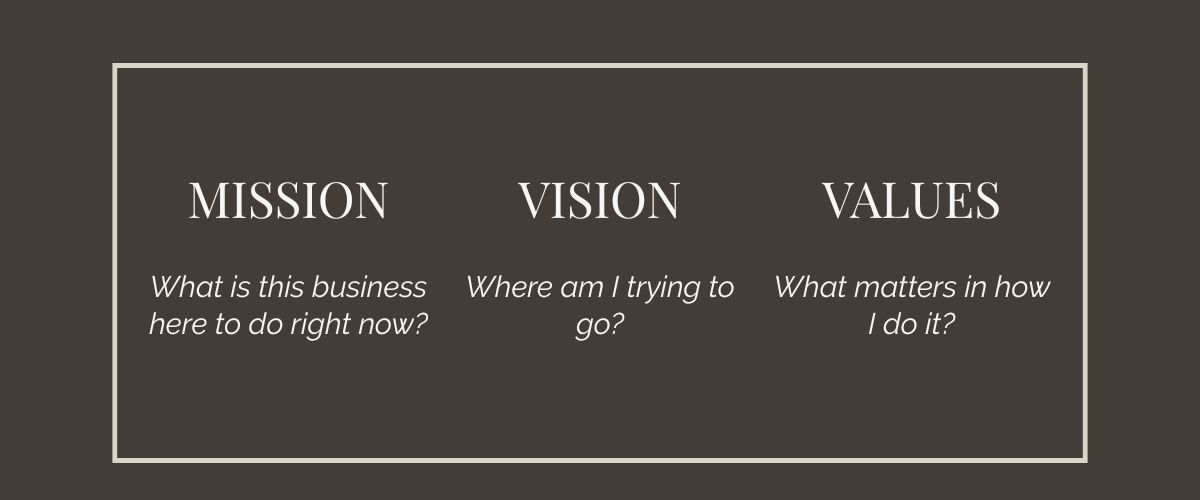
Your mission is what your business is here to do now.
Your vision is where you want the business to go.
Your values are the things that matter in how you run it.
We'll talk about vision and values separately because otherwise this is going to become a very long conversation.
For now, we're trying to answer one thing:
What is my equine photography business here to do?
So let's figure that out.
First, Who Do You Actually Want to Serve?
Don't try to write the mission statement yet.
Seriously. Put the fancy sentence aside.
Let's talk about your business first.
Who do you actually want to photograph? And I'm going to make you go a little farther than “horse people.”
Do you want to work with horse owners who want artwork of the horses they love?
Equestrian seniors and their families? Competitive riders? Breeders? Trainers? Barn owners? Equestrian businesses?
Maybe you're reading that list thinking, Well...several of those.
That's fine.
We're not trying to force you into one tiny box. We're trying to figure out whether there's a common thread.
Because the mission for a photographer who wants to create artwork for horse owners probably shouldn't sound exactly like the mission for someone who wants to help equestrian businesses market themselves.
They're both equine photographers.
They're just doing very different jobs.
Okay, So What Are You Really Providing?
The obvious answer is photographs.
But let's go a little farther.
A horse owner probably isn't hiring you because she has no photographs of her horse. I'm willing to bet her phone is currently holding approximately 8,427 of them.
So why hire you?
Maybe she wants something she can't create with her phone.
She wants artwork of the horse she's loved for 20 years.
Maybe an equestrian senior wants portraits with the horse who has been such a huge part of her teenage years.
Maybe a breeder needs images that actually show the quality of the horses she's producing.
Maybe an equestrian business owner is tired of digging through her phone every time she needs something to post and wants a library of professional images she can use on her website, social media, advertising, and marketing.
See where we're going?
You're creating photographs, yes.
But there's a reason those photographs are needed.
That's what we're looking for.
And Why Does That Matter?
Now we're getting to the good stuff.
Why does what you create matter to the person hiring you?
And we don't have to turn this into something incredibly profound. Sometimes business exercises make us feel like we're supposed to uncover the meaning of life before lunch.
We're not.
We're just trying to understand why the work matters.
Think about my own photography for a minute.
For my portrait clients at Ride the Sky, I've always cared about the relationship between the horse and the person. I'm not simply trying to make a technically good photograph of a horse. I want to create something that means something to that person because of who that horse is to them.
My Horse at Liberty work is different.
There, I'm interested in the horse itself. Movement. Muscle. Personality. All the little things that make that horse that horse.
Then put me in an equestrian business, and I'm thinking differently again. Now I'm asking what the business needs these photographs to accomplish. Where are they going to be used? What does the client need to communicate? What images are actually going to help them do that?
Same photographer.
Same camera.
Completely different reasons for creating the images.
That's what I want you thinking about with your own work.
Why are you doing this kind of photography for these people?
Now Look at What Keeps Showing Up
Okay, now take everything you've just thought through and look for the common thread.
Maybe you keep coming back to the relationship between horses and their people.
Maybe everything seems to lead back to creating physical artwork.
Maybe you care deeply about documenting a particular stage of someone's life.
Maybe what really excites you is celebrating the horse itself.
Maybe you love helping equestrian businesses look as professional as they actually are.
There's probably something that keeps showing up.
That's what we're trying to put into words.
And this is where people tend to freeze because suddenly we're supposed to turn all these thoughts into one perfect sentence.
Don't.
Write the ugly version first.
Seriously.
It's much easier to edit a mediocre sentence than it is to edit a blank page.
Now We Can Actually Try to Write the Thing
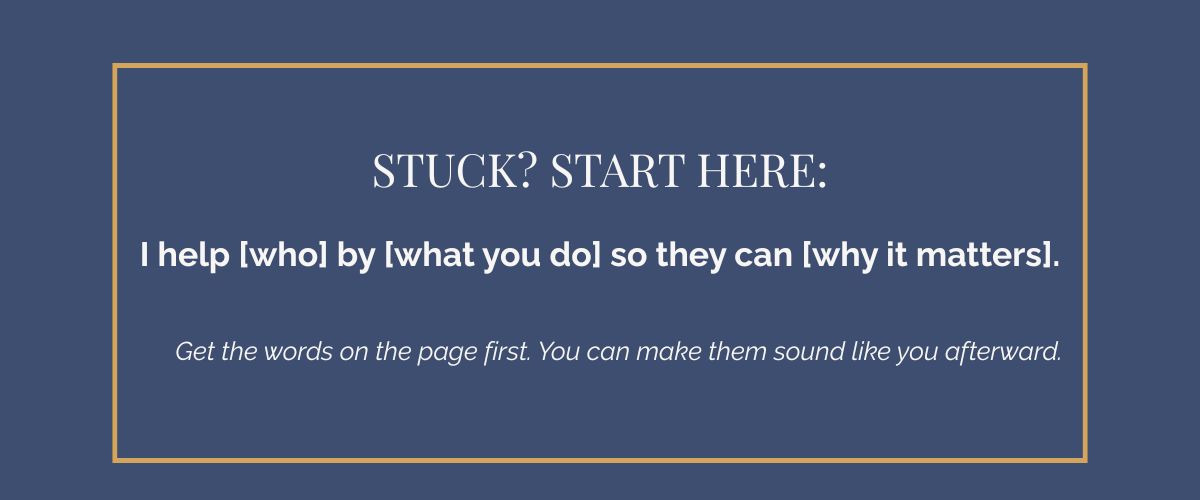
If you're staring at the blank page thinking, Great, Betsy. I know who I serve and why it matters. I still don't know what to write, start here:
I help [who] by [what you do] so they can [why it matters].
Is that going to be the mission statement you frame and hang on the wall? Probably not. But we're trying to get words on the page right now, not win an award for Best Mission Statement.
So let's say you write:
I help horse owners create professional portraits of their horses so they can preserve the relationship they have with them.
Okay. There's nothing wrong with that. We know who you serve, what you do, and why it matters.
But now we can play with it. Maybe what you really mean is: To create meaningful artwork that celebrates the relationship between horses and the people who love them.
There we go.
Same idea. It just sounds more like a mission and less like we filled in the blanks on a worksheet.
And please don't get stuck on whether you're supposed to say “I,” “we,” or “our mission is.”
If you're a one-person business, you don't suddenly have to become “we” because you're writing something official.
Nobody needs to wonder who all these other people are.
Use the language that sounds natural for your business.
And if the first version is terrible? Good. Now we have something to edit.
Let's Look at a Few Different Equine Photography Businesses
Examples can help here, especially because I want you to see how different these statements can be.
Let's say you're an equestrian senior photographer. Your mission might be:
To create portraits of graduating equestrians with the horses that shaped their lives, preserving this chapter for seniors and their families.
But maybe you specialize in horses at liberty:
To create expressive portraits that celebrate the movement, personality, and beauty of the individual horse.
Or maybe you're an equestrian brand photographer:
To help equestrian businesses communicate who they are and what makes them different through strategic photography created around their brand and goals.
And for a horse and rider portrait photographer:
To create meaningful artwork that celebrates the relationship between horses and the people who love them.
Notice that we're not trying to make all four sound alike.
That's the point.
They shouldn't.
Please Don't Just Copy the One You Like Best
I know. I just gave you examples and now I'm telling you not to use them.
Helpful, right?
But this is where examples can get us into trouble.
You read one and think, Oh, I like that one.
Great.
What do you like about it?
That's the useful part.
Maybe you like the emphasis on relationships. Maybe you like the idea of creating artwork. Maybe you're drawn to the business-focused example because that's where you want your own photography to go.
Use that information.
Just don't take someone else's mission, change three words, and call it a day.
Because then we haven't actually figured out your mission.
And the whole point of this exercise was figuring out what your business is here to do.
Don't Try to Stuff Your Entire Business Into One Sentence
This is another place where things can go sideways.
Once we start writing, suddenly everything feels important.
The client matters.
The artwork matters.
The experience matters.
Your photographic style matters.
Your values matter.
Your location matters.
The fact that you know horses matters.
Pretty soon you've got a mission statement that's 83 words long and needs its own table of contents.
We don't need all of it in there.
You have an entire website to explain your business.
The mission statement is just trying to capture the central purpose.
If you find yourself desperately trying to work one more thing into the sentence, ask whether it actually changes the mission.
If it doesn't, let it go.
Here's Where the Mission Statement Becomes Useful
Once you've written something you like, compare it to the business you're actually running.
This is where things can get interesting.
Let's say your mission is about creating finished artwork that celebrates the relationship between horses and their people.
Great.
Now look at your website.
What are you talking about?
If most of your marketing is about getting 75 digital files, that's worth noticing.
Or maybe your mission says you're helping equestrian businesses build stronger brands, but almost everything on your website speaks to portrait clients.
Also worth noticing.
It doesn't automatically mean you're doing anything wrong.
Maybe the mission isn't quite right yet.
Maybe the business has changed and the mission hasn't caught up.
Maybe your marketing doesn't reflect the business you're trying to build.
Or maybe you've been saying yes to so many different things that your business has wandered off in six directions while you were busy editing.
It happens.
But now you've spotted it.
That's useful.
And Then You Have to Actually Use It
This is the part I don't want you to skip.
Please don't spend all this time writing a mission statement, put it in your business plan, and never look at it again.
The whole point is to actually use the thing.
Let's say you're thinking about adding a new type of session.
Does it make sense for the business you just described?
You're planning your marketing for next year.
Are you talking to the people you said you wanted to serve?
You're thinking about adding a new product.
Does it support what you're trying to provide for your clients?
An opportunity comes along that sounds interesting.
Does it belong in this business?
That doesn't mean the mission statement gets to boss you around.
You can change direction. You can experiment. You can discover that you absolutely love something you never expected to photograph.
But when you keep adding things that have nothing to do with what you said you wanted the business to be, it's probably time to look at what's happening.
Maybe the mission changed.
Maybe you're distracted by the newest shiny thing.
I've certainly never seen a photographer do that before.
Your Mission Statement Is Allowed to Change
And while we're talking about changing direction, your mission statement isn't permanent.
The business you're building today may not be the business you're running five years from now.
That's normal.
You learn what you love.
You learn what makes money.
You learn what clients want.
And, equally important, you learn what you never want to do again.
All of that changes the business.
Maybe you decide you want fewer clients and higher sales.
Maybe you move away from events and toward portraits.
Maybe you add commercial photography.
Maybe you discover that one particular part of your business is the thing you want to be known for.
If the business changes, go back and look at the mission.
Does it still fit?
If it does, great.
If it doesn't, change it.
We're running a business here. We're not preserving the mission statement for a museum.
So, What Is Your Equine Photography Business Here to Do?
That's really what I want you to walk away thinking about.
Not: What am I supposed to put in a mission statement?
Instead:
Who do I want to serve?
What am I really providing for them?
Why does that matter?
Start there. Write the ugly version. Then work on the words. Read it out loud. Does it sound like you? Does it describe the business you're actually trying to build?
If not, keep playing with it.
Because the goal isn't to check “write mission statement” off the business-owner to-do list.
The goal is to understand what you're trying to accomplish with this business.
Once you know that, writing the sentence is the easy part.
Frequently Asked Questions
How long should an equine photography mission statement be?
Keep it short enough that you can actually remember what it says. For most photography businesses, one or two sentences is plenty.
If you need an entire paragraph to explain the mission, go back and look for the central idea. What is the most important thing you're trying to say about who you serve, what you do for them, and why it matters?
What's the difference between a mission statement and a vision statement?
Your mission describes what your photography business is here to do now. Your vision describes where you want the business to go in the future.
Think of the mission as the business you're running and the vision as the business you're working toward.
Can I change my photography business mission statement later?
Absolutely.
Your business may change as you specialize, change your business model, add or remove services, or discover what kind of work you really want to be doing.
Your mission statement should still describe the business you're actually trying to run. If it no longer does, change it.