How to Write a Vision Statement for Your Equine Photography Business
So you've figured out what your business is here to do.
Now what are you trying to build?
That's really the question behind a vision statement.
You'll sometimes see a vision statement explained as where you want your business to be in five or ten years. And that's fine, except I don't know exactly what my business is going to look like ten years from now.
Neither do you.
Things change. Opportunities show up. You try something you thought you'd love and discover you never want to do it again. Something you hadn't really planned on might become a pretty important part of your business.
So I'm not terribly worried about whether you can predict what your business will look like ten years from now.
I do think you should have some idea which direction your equine photography business is heading.
You may want to photograph rodeos. Or become known specifically for reining shows. Maybe you want to travel a particular cutting circuit, or build a mini-session business that takes you from barn to barn during certain times of the year.
Someone else wants a small number of portrait clients and large artwork sales. Another photographer wants to work with breeders. Or equestrian businesses. Or seniors and their horses.
And plenty of photographers are going to combine several of those things.
Those aren't different levels of an equine photography business. They're just different businesses.
The question is which one you're trying to build.
Quick Answer
A vision statement for an equine photography business describes what you're working toward. While your mission statement explains what your business is here to do now, your vision describes what you want the business to become.
It doesn't have to predict exactly where you'll be in five or ten years. It just needs to give you enough direction to make decisions about what you're building, what you want to change, and what probably doesn't belong.
What's the Difference Between a Mission Statement and a Vision Statement?
We talked about this briefly when we worked through mission statements, but it's worth separating the two.
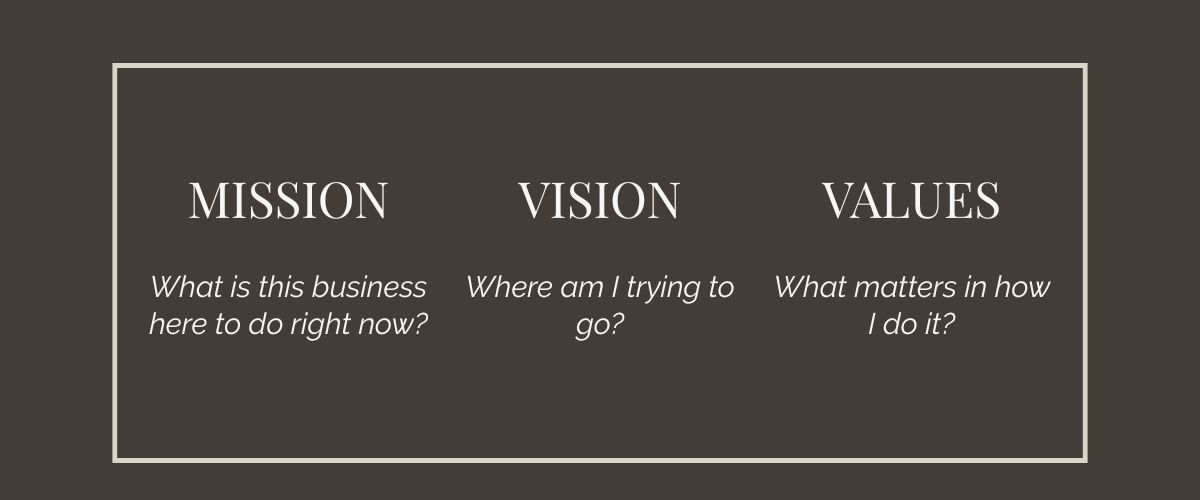
Your mission asks: What is this business here to do?
Your vision asks: What am I trying to build?
I don't think we need to make it more complicated than that.
Let's say you photograph several kinds of horse shows right now, but you've realized that reining is where you really want to specialize.
Your mission might describe what you provide for the competitors, owners, trainers, or organizations you serve.
Your vision might be to become a sought-after reining photographer covering major shows throughout your region.
That doesn't mean you need to immediately stop photographing everything else.
Maybe those other shows are profitable. Maybe you really enjoy them. Maybe they're putting you in front of exactly the people you want to know.
You're simply saying, This is where I'd like more of my business to go.
And once you know that, you can start making decisions with it in mind.
Start With the Business You Actually Want
Before we try to write anything, forget about the vision statement for a minute.
If your photography business could look the way you genuinely wanted it to look, what would that be?
And I mean what you want. Not what you've seen another photographer build and thought you were probably supposed to want too.
I think it's really easy to inherit somebody else's definition of a successful photography business without realizing we've done it.
More clients. Higher sales. A studio. Employees. Travel. Awards. Speaking. A huge social media following.
You can want all of those things.
You can also look at that list and think, No, thank you.
Maybe you'd love to travel the country photographing rodeos every weekend. Someone else just read that and immediately wanted a nap.
You might want to photograph three big horse shows a year and have those events bring in a substantial part of your income. Or you might prefer doing mini-sessions at local barns and being home for dinner.
You could want ten portrait clients a year. You could want 150.
Neither number tells me whether you have a successful business. It tells me what kind of business you're trying to run.
Photography may not even be something you want to turn into your full-time job. You might like your job. You just want the photography business to be profitable, pay for itself, and bring in additional income doing something you enjoy.
That's a very different business from the one someone is building because she wants to leave her full-time job within three years.
So before you write a vision that sounds good, figure out which business actually sounds good to you.
What Would You Like to Be Known For?
Here's another way to think about it.
Imagine someone is referring you a few years from now.
What do you hope she says?
You need to call her. She's the photographer who...
How do you want that sentence to end?
Maybe you're the photographer everyone recommends for the big cutting events. Or the person equestrian seniors in your area seem to know before they're even ready to book.
Maybe barns bring you in several times a year for mini-session days because you've built a system that makes the whole thing easy for them.
You could become known for photographing one particular breed. Or black-background portraits. Or working with breeders and sale horses.
And you don't necessarily have to be known for one specific type of photography. People may refer you because of the experience you create, how well you understand horses, or the kind of clients you work with.
The important part is whether that's what you actually want to be known for.
Because if it isn't, that's worth knowing before you spend the next five years building more of it.
What Do You Want the Business Itself to Look Like?
What you photograph is only part of this.
You also have to think about what you want the actual business to look like.
For example, let's say you love photographing horse shows.
Great. What does that mean?
Do you want to photograph a lot of smaller local shows or a handful of large ones? Stay within a few hours of home or travel nationally? Sell individual images to competitors? Work directly for show management? Have multiple photographers working under your business eventually?
Those are all very different versions of “I want to photograph horse shows.”
Same thing with mini-sessions.
Maybe you want to do them a few times a year as a special promotion. Or maybe you can see yourself building a high-volume model where you spend several weeks traveling from barn to barn.
Portrait photography can go a dozen directions too.
This is where I want you to get more specific.
How much do you actually want to work? What do you want to sell? How much travel sounds fun, and at what point does it stop being fun? Do you want to stay a solopreneur? Would you eventually like employees, or would you rather outsource a few things and keep the business itself small?
And yes, we need to talk about money.
Do you want photography to provide all of your income? Part of it? What does the business actually need to earn for the life you want it to support?
Some of your answers may start arguing with each other.
That's normal.
You may decide you want to photograph shows every weekend, travel nationally, and also never miss a weekend at home.
We have a problem.
Or you may think you want a studio until you start thinking about the expense and realize what you really want is somewhere reliable to photograph when it's pouring rain.
That's not the same thing at all.
Sometimes figuring out what you don't want is easier. I think that counts. I've made plenty of business decisions because I knew I didn't want to keep doing something the way I'd been doing it.
Specializing Doesn't Always Mean Changing What You Do
I think this is worth talking about because we tend to associate having a vision with making some big change.
It doesn't have to be.
You might already be doing the thing you want to do.
A horse-show photographer may decide she wants to concentrate more heavily on dressage. A rodeo photographer might want to work within a particular association or circuit. Someone photographing cutting horses may eventually want to cover major national events.
Or maybe you've been offering mini-sessions for years, they're profitable, clients love them, and you've realized you'd like to build more of the business around them.
You don't necessarily need to add something new.
You may need more of what's already working.
And you certainly don't need to “graduate” from one type of photography to another.
There's no ladder here.
What Needs to Change to Get There?
Now look at the business you just described and compare it to the one you're running.
What's different?
This is where you may start seeing the gap.
You're photographing every equestrian discipline that comes your way, but you'd really like cutting shows to make up most of your calendar.
You've been doing minis occasionally, but now you're thinking there's a real business model there if you can get the barn partnerships and systems figured out.
Most of your event income comes from individual competitors, but you'd like to start working more directly with show management or sponsors.
Or you're doing portraits and events and you actually like doing both.
Good. Keep both.
You don't have to eliminate something simply because you're writing a vision statement.
You may also get to this point, look at the business you're already running, and realize you're pretty close to what you want.
I wouldn't go looking for something to change just so you can say you have a vision.
Maybe the next few years are about making this business more profitable, fixing the parts that are making your life unnecessarily difficult, and doing more of the work you already like.
Now Try Putting It Into Words
Okay, now we can actually try to write the thing.
Start with: I am building a photography business that...
And finish the sentence.
Don't worry about whether it sounds like a vision statement yet.
You could end up with something like:
I am building an equine photography business known for covering major reining events throughout the Southeast.
Or:
I am building a seasonal mini-session business that partners with barns throughout my region to create portraits for their riders and horse owners.
A part-time photographer might write:
I am building a profitable equine photography business specializing in barrel racing events while keeping my full-time career.
And someone building a portrait business could have:
I am building a portrait business creating commissioned horse-and-rider artwork for a limited number of clients each year.
Your first version may be clunky.
Fine.
Get the idea out of your head first. We can fix the sentence.
You may keep “I am building.” You may hate it once you read it out loud and change the whole thing.
The wording matters less to me than whether you read it and think, Yes. That's actually what I'm trying to do.
Your Vision Should Help You Make Decisions Now
This is where having the vision written down starts earning its keep.
Let's say you want to become known for photographing cutting events and another kind of show contacts you.
Do you take it?
Maybe.
I know. Very helpful.
But this isn't supposed to be a rule that makes every business decision for you.
It might be a great-paying job. You may love photographing that particular show. Maybe you'll meet trainers there who also compete in cutting. Or maybe you simply have an open weekend and want to do it.
On the other hand, if your calendar is already packed and saying yes means you won't have room for the cutting events you say you want more of, that's different.
Now you have something to compare the opportunity against.
Does this make sense for the business I'm trying to build?
Sometimes it will.
Sometimes it won't.
And sometimes you're going to know perfectly well that it doesn't move you toward the long-term vision and take the job anyway because it makes sense right now.
Businesses have bills. Life happens.
You don't have to turn every decision into evidence that you're following some beautifully coordinated ten-year plan.
But I do think there's a difference between occasionally making a decision that doesn't fit the long-term plan and looking up three years from now to realize you've spent all your time building a business you didn't actually want.
Your Vision Can Change
I'd be a little surprised if the vision you write today still fits your business perfectly five years from now.
You haven't met all your future clients yet. You don't know which opportunities are going to show up.
You may discover a discipline you love photographing. You may get tired of traveling. Something you thought would be a great business opportunity may turn out to be something you don't particularly enjoy.
And something you thought would be a small part of the business might end up becoming a pretty big part of what you do.
Experience changes the plan.
So pull your vision back out occasionally.
Not every Tuesday. We do not need another business document that requires weekly maintenance.
But if the business starts changing, you're considering a major shift, or you realize you're working really hard toward something you're not even sure you want anymore, it's probably worth another look.
Does this still describe where I want to go?
If not, rewrite it.
So What Are You Actually Trying to Build?
That's the question.
Not what should a successful equine photography business look like.
There isn't one answer.
A successful reining photographer and a successful equestrian senior photographer may have businesses that barely resemble each other.
Someone doing hundreds of mini-sessions may have completely different goals from someone photographing ten commissioned clients. A part-time photographer can be running exactly the business she wants while another photographer is working toward replacing her full-time income.
The vision isn't about figuring out the next level of your photography business.
Your vision statement is about figuring out which direction you want your photography business to go.
What do you want to photograph? Who do you want to work with? What do you want to be known for? How do you want the business to make money?
And what role do you actually want this business to play in your life?
Start there.
Then put it into words.
You probably won't end up exactly where you thought you would. That's okay.
You just need to know which direction you're trying to go.
Frequently Asked Questions
How long should an equine photography vision statement be?
A vision statement doesn't need to be long. One or two sentences is usually enough to describe the direction you're trying to take your photography business.
If it takes several paragraphs to explain, you probably haven't gotten down to the main idea yet. Keep the longer thoughts for your business plan. The vision statement just needs to remind you what you're trying to build.
How far into the future should a vision statement look?
You'll often see five to ten years recommended, but I wouldn't get too hung up on the number.
Think far enough ahead that you're describing what you want the business to become rather than what you need to finish next month. For one photographer, that might mean three years. Someone else may genuinely be thinking ten years ahead.
The timeframe matters less than having a direction.
What's the difference between a mission statement and a vision statement?
Your mission statement describes what your photography business is here to do now. Your vision statement describes what you're working toward.
An easy way to remember it is:
Mission: What is this business here to do?
Vision: What am I trying to build?
Can my equine photography business vision change?
Absolutely. In fact, I'd expect it to.
You may specialize, discover a new revenue stream, change how much you want to work, move into a different type of equine photography, or simply decide that something you thought you wanted isn't what you want anymore.
When the direction of the business changes, the vision should change with it.