How to Write a Value Proposition for Your Equine Photography Business
Why should someone hire you instead of another equine photographer?
That's basically the question a value proposition is supposed to answer.
The problem is, I think we hear that question and immediately turn it into: What makes me unique?
And suddenly we're trying to come up with something no other photographer on the planet has ever done.
Good luck with that.
You probably aren't the only photographer who photographs horse shows. Or creates wall art. Or works with breeders. Or offers equestrian senior sessions. Or provides video along with still photography.
That's okay.
You don't need to invent an entirely new form of horse photography to give someone a reason to choose you.
What you do need to understand is why the right client would choose you.
Quick Answer
An equine photography business value proposition explains why the right client should choose your photography business instead of another option. It connects who you serve with what they want or need, what you provide, and why your particular approach is valuable to them.
It doesn't require you to offer something no other photographer offers.
And while you can eventually turn your value proposition into a sentence for your website or marketing, I wouldn't start by trying to write the sentence.
First, figure out what your clients actually value about working with you.
What's the Difference Between a Mission, Vision, Brand Values, and a Value Proposition?
We've been working through several pieces of an equine photography brand, and this is where the client becomes a much bigger part of the conversation.
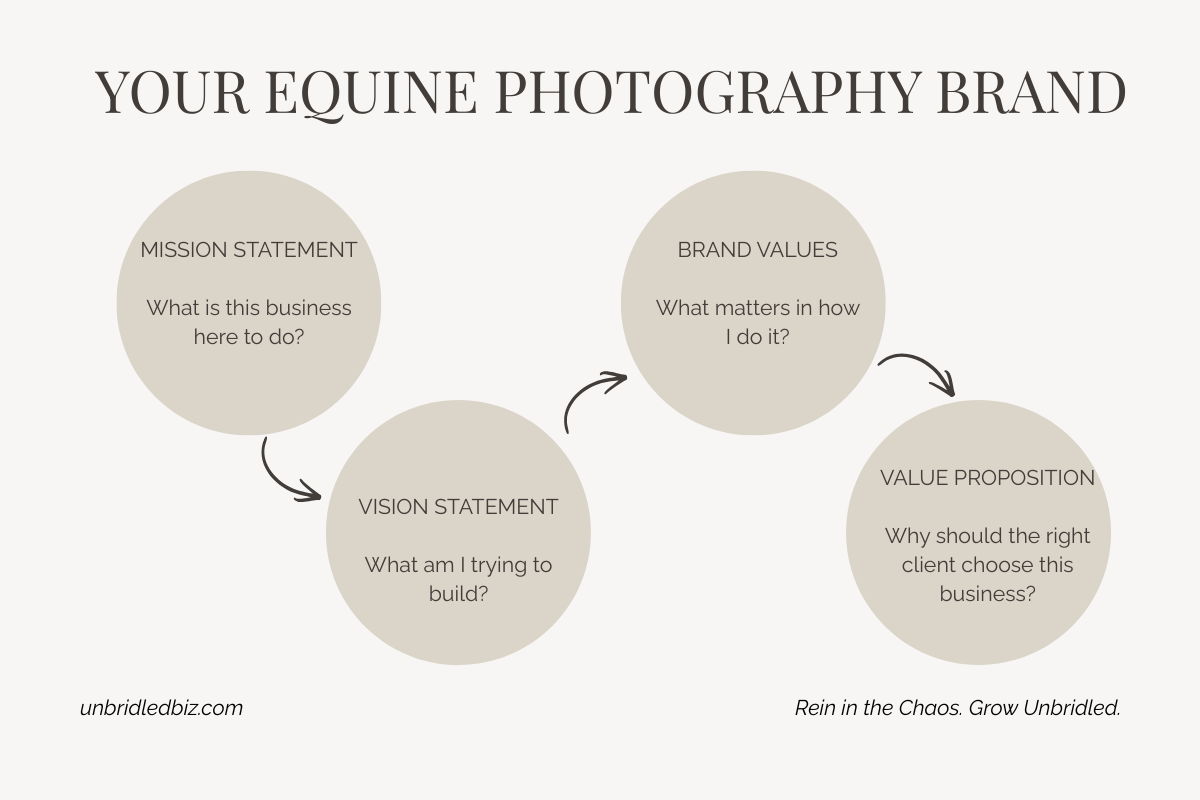
Your mission asks: What is this business here to do?
Your vision asks: What am I trying to build?
Your values ask: What matters in how I do it?
And your value proposition gets us to: Why should the right client choose this business?
Now we have to think about what the client actually wants.
And that isn't always as obvious as it sounds.
You Don't Have to Be Completely Unique
I think the word unique gets us into trouble here.
Of course you should understand what differentiates your business. But there's a difference between being different in a way that matters to a client and desperately trying to find something nobody else does.
Let's say there are three photographers covering the same reining circuit.
One has photographed that circuit for years. She knows the riders, trainers, horses, patterns, and the moments competitors care about.
Another has built a ridiculously efficient system and gets galleries online quickly while everybody is still excited about the show.
The third creates competition photographs along with short-form video because many of her trainer and breeder clients need content for their own marketing.
All three photograph reining.
A rider, trainer, or breeder could have a perfectly good reason for choosing any one of them.
That's what we're looking for.
Not necessarily the thing that makes you the only photographer who can do what you do.
The reason your client sees you as the right choice.
Is There a Formula for Writing a Value Proposition?
The original version of this article included this: We help [target client] [achieve goal or benefit] by [what you do].
There's nothing particularly wrong with it.
I still think it's useful.
I just wouldn't start there anymore.
Because you can fill in every blank and end up with a sentence that sounds perfectly respectable while saying almost nothing.
For example: We help horse breeders market their horses with professional photographs that show them at their best.
Okay.
But now I have questions.
What does this photographer understand about photographing breeding stock? Are they especially good at conformation images? Do they know how to photograph stallions safely and efficiently? Do they understand what mare owners want to see when they're researching a stallion?
And what is the breeder actually getting? Still photographs? Movement? Video? Content for a website, social media, advertisements, breeding announcements?
There could be a really good value proposition in there.
We just don't know enough yet.
That's why I wouldn't start by filling in blanks.
Who Is Actually Hiring You, and Why?
Before worrying about wording, I'd spend some time here.
Who is this particular client?
Why are they looking for a photographer in the first place?
And why now?
A breeder marketing a stallion has a very different reason for hiring a photographer than a mother planning her daughter's equestrian senior portraits.
A trainer who needs sale-horse photographs has a different job to get done than a rider looking for images from last weekend's hunter-jumper show.
Even two people involved in the same photography session may care about different things.
Think about an equestrian senior session.
The senior may care most about having photographs with the horse that has been part of almost every important part of growing up.
Her mother may be looking at the same session and thinking, She's leaving for college next year.
They're buying the same photography.
That doesn't mean they're valuing it in exactly the same way.
And that matters when you're trying to understand why someone chooses you.
What Are They Really Getting From You?
Sometimes the answer is closely tied to what you photograph.
A breeder may value a photographer who understands conformation, movement, pedigrees, and what prospective buyers or mare owners need to see.
A sale-horse photographer needs to create images that make the horse look his best without making him look like a horse he isn't.
Someone photographing an equestrian business has another job entirely. Those photographs may need to work on a website, in advertising, across social media, in print, and anywhere else that business needs to show people who they are and what they do.
Subject knowledge matters in all three cases, but for different reasons.
And sometimes what the photographer knows isn't the main reason the client chooses them at all.
It may be the way the whole thing works.
How You Work Can Be Part of the Value
This is one of the reasons two photographers can offer what looks like the same service and still appeal to different clients.
Some clients want a lot of guidance.
Others absolutely do not.
Someone may love having a photographer help plan clothing, location, session details, image selection, and finished artwork.
Another client may want to book online at 11:30 at night, show up at the barn Saturday morning, have photographs made in twenty minutes, choose digital files from a gallery, and get on with her life.
I can already tell you those two clients probably shouldn't be shopping for the same photographer.
And that's fine.
Convenience can be valuable.
So can personal attention.
Speed can be valuable.
So can taking more time.
The interesting question isn't which experience is better.
It's which experience matters to the people you're trying to serve.
Don't Forget What They Get at the End
This sounds obvious, but I think photographers sometimes spend so much time talking about the session that we forget the client may be much more interested in what happens afterward.
A show competitor wants to find the photographs from her rides.
A breeder may need an entire collection of images and video that can be used throughout a stallion's breeding season.
A commercial client might need enough varied content to stop recycling the same twelve photographs for the next six months.
Someone else wants a finished portrait hanging over the fireplace.
What the client ends up with is part of the value too.
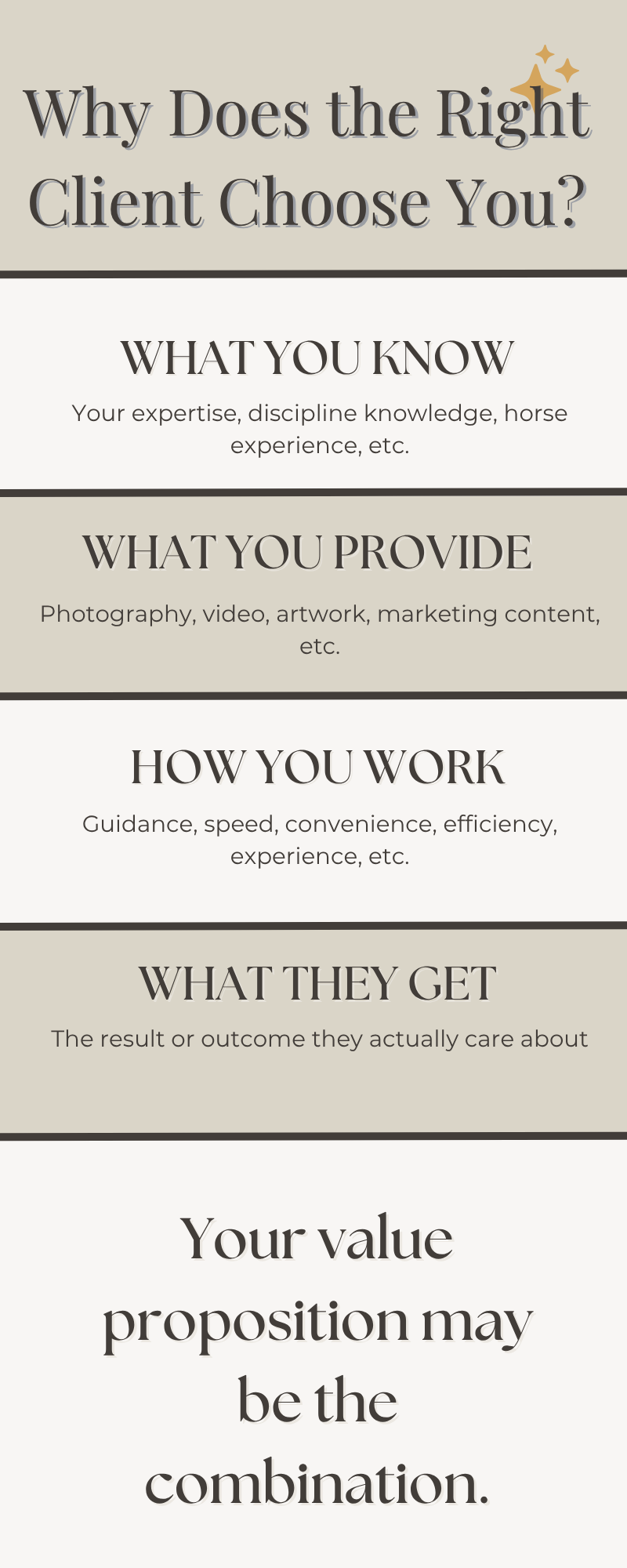
And once you start looking at the business this way, you can usually see that the reason people hire you isn't one isolated thing.
It's Usually the Combination
Let's say you photograph a hunter-jumper circuit.
You understand the sport well enough to anticipate the moments riders actually want photographed. You've built a system that makes thousands of show images easy to find. And you get galleries online quickly enough that riders can purchase while they're still excited about the weekend.
Another photographer may do one or two of those things.
That's not a problem.
Put them together and I can understand why a rider at that circuit might keep looking for your tent or website every time she shows.
That's a value proposition.
We still haven't turned it into a polished sentence, but we know what makes the service valuable.
I'd much rather have that figured out first.
Should You Look at Other Photographers?
Yes.
I just wouldn't start there.
You should know what's happening in your market. You should know what clients see when they compare you with other photographers.
But opening twelve photographers' websites before you've thought seriously about your own business makes it awfully easy to start building yours in reaction to theirs.
Figure out who you're serving and why they value what you do first.
Then go look.
You might discover something you assumed everybody offered isn't actually common in your market.
You might also discover the thing you've been proudly calling your differentiator is on six other homepages.
Well, that's useful information too.
It doesn't mean you have to throw it away.
It may mean you need to understand more specifically why that thing matters when you do it.
So What Are We Actually Trying to Say?
At this point, we know a lot more than we did when we started.
We know who the client is. We know what they care about. We know what we're providing and why that particular combination matters to them.
Now the formula can actually help.
You could start with:
We help [specific client] [get something they value] through/by [the relevant way you provide it].
Just don't get overly attached to filling in the blanks perfectly.
Let's go back to the breeder example.
We started with: We help horse breeders market their horses with professional photographs that show them at their best.
After thinking about the client and the value a little more, perhaps what we actually mean is closer to: We create photographs and video for sport-horse breeders who need to show prospective buyers and mare owners what their horses actually have to offer, from conformation and expression to movement.
Now I understand more.
If this particular photographer also has deep experience with stallions or a specific breed, that may belong in the message somewhere too.
Does every single detail have to fit into one sentence?
Please don't.
At some point we're writing a paragraph.
The value proposition gives you the core idea. Your website has plenty of room to support it.
Where Should You Use Your Value Proposition?
Here's another place where I think we make things unnecessarily difficult.
Your value proposition doesn't necessarily have to appear word for word anywhere.
You may work through this exercise, write one for yourself, and never paste that exact sentence onto your website.
That's fine.
What matters is whether someone can understand the idea when they look at your marketing.
If trainers hire you because you understand their discipline and don't need them to stop everything they're doing to manage you, your website should give them some reason to believe that.
If riders love how quickly they can find and purchase show photographs, don't hide that information three pages deep.
If your commercial clients end up with months of useful marketing content instead of twelve slightly different headshots, show them that.
And if you guide portrait clients all the way from planning through finished artwork, make sure your website doesn't accidentally make the experience look like “show up, smile, download files.”
You don't have to keep repeating your value proposition word for word.
But the reason someone should choose you shouldn't be a secret either.
Your Value Proposition Can Change
Mine has.
Your business five years from now may not give clients the same reasons to choose you that it does today.
Sometimes that's because you've deliberately changed what you offer. Other times, clients start hiring you for something you hadn't realized was particularly valuable.
Pay attention when that happens.
You may also discover you've spent years talking about something you think is important while your clients are much more interested in something else entirely.
That's worth knowing too.
Your value proposition doesn't need to remain untouched because you wrote it in a business plan years ago.
It needs to make sense for the business you're actually running.
Why Should the Right Client Choose You?
That's the question I'd come back to.
You don't have to prove you're unlike every other equine photographer.
You need to understand the people you're trying to serve well enough to know why what you provide matters to them.
For one photographer, that may have a lot to do with expertise in a particular discipline. Somewhere else, speed and convenience may be a huge part of the reason clients buy. A breeder, trainer, horse-show competitor, equestrian business owner, senior, and horse owner aren't necessarily looking for the same things from a photographer.
And neither are all photographers trying to build the same business.
That's the part worth figuring out.
Once you understand why the right client would choose you, figuring out how to say it gets a whole lot easier.